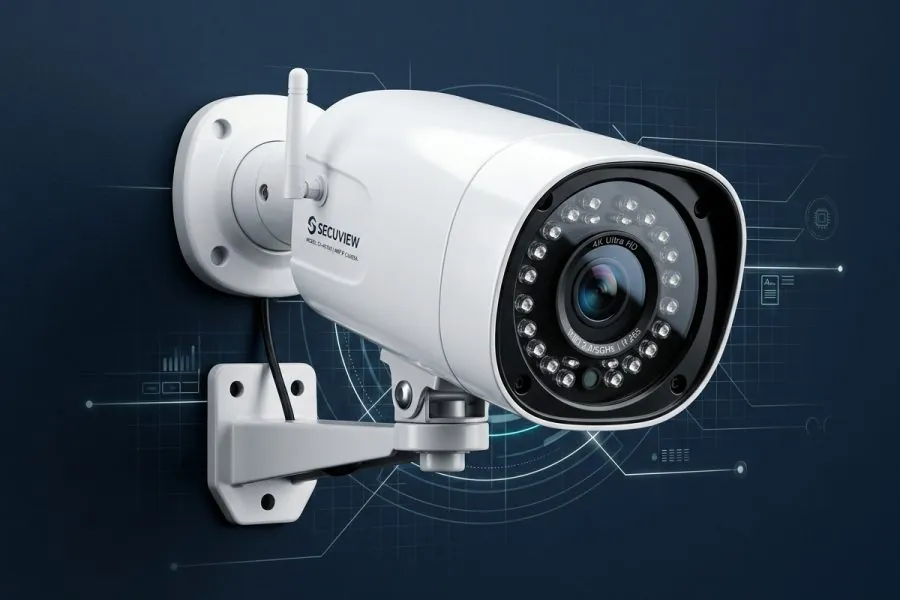
When designing a commercial surveillance system for Perth warehouses, retail storefronts, or office car parks, business owners frequently ask whether 4K (8 Megapixel) resolution is truly necessary or if commercial-grade 4MP IP cameras provide better value.
While 4K sounds superior on paper, optical performance involves more than just raw pixel counts. Sensor size, low-light sensitivity, storage bandwidth consumption, and field of view play crucial roles in real-world identification.
The Resolution Breakdown: 4MP vs 4K Ultra HD
To understand the difference, consider the pixel dimensions:
- 4MP (2K QHD): 2560 x 1440 pixels (3.7 million pixels). Nearly double standard 1080p Full HD.
- 8MP (4K UHD): 3840 x 2160 pixels (8.3 million pixels). Four times standard 1080p Full HD.
The “Pixels on Target” Rule (DORI Standard)
In commercial surveillance, identification requires at least 250 pixels per metre. A 4K camera can identify a suspect face across an 8-metre horizontal width, whereas a 4MP camera achieves this across roughly 4 metres with identical lenses.
Night Vision Performance & Low-Light Sensitivity
Counterintuitively, a 4MP camera often outperforms an entry-level 4K camera in pitch darkness. Why? Because each individual pixel (photodiode) on a 4MP sensor is larger, allowing it to capture more ambient light photons.
For unlit commercial car parks in industrial precincts like Welshpool, Malaga, or Kwinana, 4K cameras should always be paired with DarkFighter or ColorVu low-light technology and supplemented by infrared or warm LED illumination.
Bandwidth & NVR Storage Calculations
Storage is an ongoing commercial consideration. With modern H.265+ smart compression:
- A 4MP camera recording at 15 FPS consumes roughly 2 to 3 Mbps of continuous bandwidth.
- A 4K camera at 15 FPS consumes roughly 6 to 8 Mbps of bandwidth.
For a 16-camera warehouse system requiring 30 days of continuous recording, 4MP requires approximately 10TB of surveillance-grade hard drive capacity, while 4K requires 24TB to 32TB across multiple drive bays.
The Optimal Hybrid Strategy
Most successful Perth enterprise installations employ a hybrid deployment:
- 4K Cameras: Positioned at main entrance turnstiles, car park entry gates, and cash-handling points for facial identification and number plate recognition.
- 4MP Cameras: Deployed throughout internal corridors, break rooms, back alleys, and general warehouse aisles where wide-area contextual coverage is sufficient.